Basement humidity monitoring follows a more continuous schedule than many hazards, given its seasonal variability.
Most home hazard testing produces a verdict. You sample, you get a result, you act on it, and you repeat at some interval. Basement humidity does not work that way, because the thing being measured changes daily with weather and seasonally by a wide margin. A single reading tells you about the hour you took it.
The more useful framing is monitoring rather than testing: an inexpensive instrument left in place, checked on a routine, producing a trend you can read. What follows is what to leave running, when to look at it more closely, and what a second instrument adds that a humidity reading cannot give you.
- Continuous hygrometer monitoring, not a one-time test, is the appropriate approach for this hazard.
- Increase attention during spring and summer, generally the highest-risk seasons in most regions.
- Periodic moisture meter spot-checks supplement continuous humidity monitoring with material-level data.
- This is a more continuous monitoring approach than for hazards with more stable, less seasonally-variable levels.
Continuous Monitoring With a Hygrometer
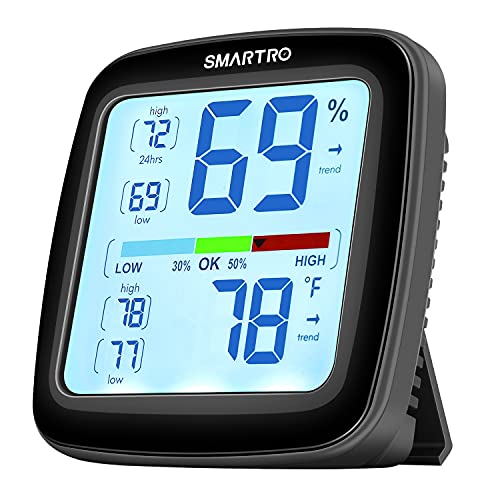
Unlike a one-time test, an inexpensive hygrometer left in place provides continuous monitoring [1], letting you track humidity trends across seasons rather than a single snapshot.
Placement drives whether the readings mean anything. A hygrometer sitting next to the dehumidifier reports on the dehumidifier. Put it somewhere that represents the space you actually care about, away from direct airflow, away from the appliance, and off the floor at roughly the height where you store things or spend time. If the basement has distinct zones, such as a finished area and an unfinished mechanical area, one reading will not describe both.
Consistency is worth more than precision here. Inexpensive hygrometers are not laboratory instruments and can be off by a few points, but a unit that is consistently off still shows direction and change accurately, which is what you are looking for. Models that log a running minimum and maximum are a genuine upgrade over models that only show the current number, because the overnight peak usually occurs when nobody is there to look at it.
Increased Attention During High-Risk Seasons
Check readings more frequently during spring (snowmelt/rainfall) and summer (high ambient humidity), the seasons with generally elevated moisture risk in most regions.
The two elevated seasons have opposite mechanisms, and knowing which one you are in determines the correct response. Spring risk is liquid water: snowmelt and sustained rain raise the water table and push groundwater against the foundation. Summer risk is condensation: warm humid outdoor air enters a cool basement and deposits moisture on surfaces sitting below its dew point [2].
That distinction matters because the intuitive summer response makes the problem worse. Opening basement windows to air out a damp space in humid weather brings in exactly the air that is causing the condensation. In spring the priority is drainage and exterior water management instead, and readings are most informative during and immediately after a storm rather than on the clear day that follows.

Moisture Meter Spot-Checks
Periodic moisture meter spot-checks on wood framing or drywall (annually, or after any known water event) supplement continuous humidity monitoring with material-level data.
A moisture meter answers a question the hygrometer cannot: whether the materials are wet, not just the air. The two commonly available types work differently. Pin meters read electrical resistance between two probes and require making small holes, which suits framing and unfinished surfaces. Pinless meters scan without penetration and are convenient for sweeping large areas, but they read only a shallow depth and can be confused by fasteners and by variations in material density. Both instruments sit alongside a short list of other accessories worth pairing with a basement moisture control setup.
For the readings to be useful you need your own baseline. Take readings across several locations while conditions are normal and write them down, so a later reading has something to be compared against. The most valuable comparison is between a suspect area and an equivalent area you believe to be dry, using the same meter on the same material, since that removes most of the calibration questions that make absolute numbers hard to interpret.
A Realistic Monitoring Routine
A workable baseline is a glance at the hygrometer whenever you are already in the basement, a deliberate look at the recorded high and low weekly through spring and summer, and a moisture meter sweep of the perimeter twice a year, timed to the start of the wet season and again at its end. Written down, this is a few minutes of work per year, and the writing down is the part that converts scattered observations into a trend.
Layer event-driven checks on top of the routine. Any sustained heavy rain, any rapid snowmelt, any plumbing incident, and any power outage long enough to have stopped a sump pump all deserve a check afterward rather than waiting for the next scheduled one. A power outage during a storm is the specific scenario in which a basement with a working pump and no battery backup still floods.
Re-establish the baseline after any significant change. Installing a drainage system, adding or replacing a dehumidifier, regrading, extending downspouts, or finishing part of the space all alter how the basement behaves, and comparing post-work readings against pre-work numbers is the only practical way to confirm the work did what it was supposed to do. That comparison is also the record you will want if a warranty conversation ever becomes necessary.
FAQ
Do I need to test my basement moisture once, or is this ongoing?
This should be ongoing — a hygrometer left in place for continuous monitoring is more appropriate than a single one-time test, given this hazard’s seasonal variability.
What is a normal humidity swing across the year in a basement?Wide, and a wide swing is not by itself a defect. Basements commonly read driest in cold weather, when outdoor air holds little moisture and heating systems are running, and highest in the humid part of summer, when warm outdoor air meets cool below-grade surfaces. What matters more than the size of the swing is whether the high end stays within the range that discourages mold growth [3][1], and whether the pattern is stable from year to year. A season that reads materially higher than the same season last year, with no change in weather, is the signal worth investigating.
Do I need a professional to monitor this, or can I do it myself?Routine monitoring is genuinely a homeowner task, and the instruments involved are inexpensive and simple to use. Professional involvement becomes worthwhile when monitoring turns up something you cannot explain: readings that stay elevated through a dry season, a moisture meter finding on framing with no identifiable source, or a persistent musty odor with nothing visible. Those are diagnostic questions rather than measurement questions, and they benefit from tools such as thermal imaging and from someone who has seen many foundations. The monitoring is what tells you when that call is warranted, which is most of its value.
A single test provides only a snapshot — continuous monitoring is more appropriate given basement moisture’s seasonal variability.
References
- A Brief Guide to Mold, Moisture, and Your Home. US Environmental Protection Agency
- Dew Point vs. Humidity. NOAA National Weather Service
- Ten Things You Should Know About Mold. US Environmental Protection Agency
These statements have not been evaluated by the Food and Drug Administration. This information is not intended to diagnose, treat, cure, or prevent any disease. Content is for informational purposes only and is not medical advice; consult a qualified healthcare provider before starting any supplement. As an Amazon Associate we earn from qualifying purchases.
