Understanding key basement moisture terminology helps you navigate assessment and remediation discussions more confidently.
The vocabulary around basement moisture is unusually mixed. Some of it is plain building science, some is borrowed from insurance, and some is contractor shorthand that means slightly different things to different companies. That matters because most of the decisions you will make, whether to install a drainage system, whether a reading is a problem, whether one quote is comparable to another, get made in conversations that assume you already know these words.
The definitions below are grouped roughly the way you will meet them: first the forces that move water, then the measurements used to describe it, then the evidence you can see with your own eyes. Where a term is commonly used loosely, that is noted, because a term used loosely in a written quote is a term that can be argued about later.
- Hydrostatic pressure is the groundwater pressure driving water intrusion — the primary force to understand.
- A vapor barrier blocks moisture vapor from passing through floors or ground covers.
- Relative humidity (RH) should generally stay below 50-60% to discourage mold growth.
- Understanding this terminology helps you interpret assessment findings and treatment recommendations.
Hydrostatic Pressure
This is the pressure exerted by groundwater against your foundation walls and floor, the primary force driving water intrusion in basements — higher water tables and clay soils increase this pressure.
The practical consequence is that hydrostatic pressure is a force, not a leak. It does not need a hole to exploit, only a path. Concrete is porous, and a block wall is a grid of hollow cores that can fill and hold water. This is why sealing a visible crack sometimes moves the problem rather than solving it: the water is still under pressure against the whole wall and will find the next available path, often reappearing several feet away or at the joint where the floor slab meets the wall.
It also explains why the pressure varies so much through the year without anything about your house changing. A rising water table after snowmelt or a long wet spell lifts the pressure against the foundation, and a dry stretch drops it. A basement that is dry for nine months and wet for three is behaving normally for a structure sitting in soil with a seasonal water table, and the fix is generally about managing water before it reaches the wall rather than about the wall itself.
Vapor Barrier
A vapor barrier is a material (often plastic sheeting) installed to block moisture vapor from passing through a surface, commonly used on basement floors or crawl space ground covers.
Vapor barrier and vapor retarder are often used interchangeably in conversation, but they describe different performance levels. The measure is permeance, expressed in perms, which describes how readily water vapor passes through a material. Lower numbers mean tighter. Materials get grouped into classes, with polyethylene sheeting at the tight end and materials such as kraft-faced insulation considerably more open. A quote that says vapor barrier without naming the material or its rating has not actually specified anything.
Placement matters as much as material. A vapor retarder installed on the wrong side of an assembly can trap moisture inside it rather than keeping moisture out, which is why below-grade wall detailing differs from the above-grade practice many people are familiar with. In crawl spaces the same product is usually called a ground cover or an encapsulation liner, and there the job is straightforward: separate the interior air from bare soil that is continuously releasing moisture upward [1].
Relative Humidity (RH)
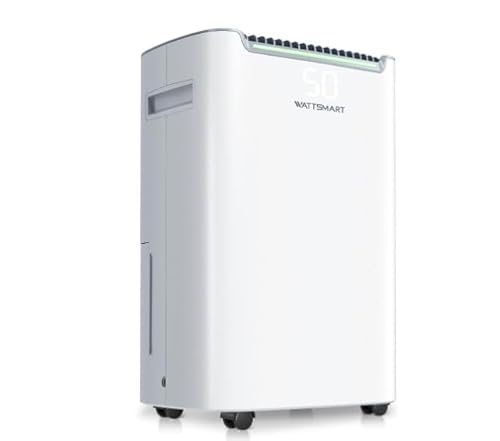
This is the percentage measure of moisture in the air relative to what the air can hold at a given temperature — basements are generally recommended to stay below 50-60% RH to discourage mold growth.
Relative humidity is relative to temperature, which is the source of most confusion about basement readings. The same amount of moisture in the air produces a higher RH reading in a cool space than in a warm one, so a basement can read high simply because it is the coldest room in the house, without any water entering it. This is why a single reading is weak evidence and a logged trend across seasons is strong evidence.
The related term worth learning is dew point, the temperature at which air becomes saturated and moisture condenses onto a surface. Summer condensation on basement walls and cold water pipes is a dew point event, not intrusion: warm humid outdoor air meets a surface sitting below its dew point. The distinction changes the fix entirely, because ventilating with humid summer air makes a condensation problem worse while doing nothing about a seepage problem.

Terms That Describe What You Are Seeing
Efflorescence is the white, crystalline, slightly gritty deposit found on masonry. It is mineral salt left behind when water moves through concrete or block and then evaporates at the surface. The deposit itself is harmless and brushes off. Its diagnostic value is what makes it worth naming: it is physical evidence that liquid water has moved through that wall, so its location maps where water is traveling even on a day when the wall looks dry.
Capillary action, sometimes called wicking, is water moving through fine pores against gravity, the same effect that draws liquid up a paper towel. It is the mechanism behind a damp band along the base of a wall, or a slab that reads wet with no visible source above it. A capillary break is any layer, usually a membrane or a coating, that interrupts that path.
Water damage is also commonly sorted by contamination rather than by volume, a convention drawn from restoration industry standards. Clean water from a supply line sits at one end, water that has passed through soil or sewage at the other, with an intermediate grade for water that is not sanitary but not grossly contaminated. That category, not the size of the puddle, drives whether porous materials such as carpet and drywall can be dried in place or have to be removed, and it is the language an adjuster and a restoration contractor will both use.
FAQ
What humidity level is considered safe for a basement?
Generally, keeping relative humidity below 50-60% is recommended to discourage mold growth — a hygrometer can help you monitor this ongoing.
Is efflorescence the same thing as mold?No. Efflorescence is a mineral salt deposit, typically white or grayish, crystalline and gritty rather than fuzzy, and it has no odor. Mold is a living growth, is more often colored, smells musty, and tends to spread across organic surfaces such as paper-faced drywall, wood, or stored cardboard rather than sitting on bare masonry. A practical field distinction is that efflorescence brushes away as a powder while mold smears. If you are unsure, treat either one as the same underlying signal, which is that moisture is reaching that surface.
What is the difference between waterproofing and damp-proofing?Damp-proofing resists moisture in vapor form and light dampness, and is the coating commonly applied to the outside of foundation walls during construction. Waterproofing is built to resist liquid water under hydrostatic pressure. The words get used loosely in marketing, so the useful question to a contractor is not which word they use but what the system does when the soil outside is saturated and under pressure, and what specifically the written warranty promises in that condition.
Terminology can vary slightly between contractors — confirm specific definitions relevant to your assessment or quote.
References
- Mold Course Chapter 2: Why and Where Mold Grows. U.S. Environmental Protection Agency
These statements have not been evaluated by the Food and Drug Administration. This information is not intended to diagnose, treat, cure, or prevent any disease. Content is for informational purposes only and is not medical advice; consult a qualified healthcare provider before starting any supplement. As an Amazon Associate we earn from qualifying purchases.