Children spending significant time in finished basement play or living areas warrant particular consideration regarding moisture and mold exposure.
The reason children come up specifically in the basement moisture literature is not that they respond differently in kind, but that the exposure profile differs. A finished basement used as a playroom is often where a child spends the largest uninterrupted blocks of indoor time, and the activity happens at floor level, which is where both settled spores and the coolest, dampest air tend to be.
- Research has documented associations between childhood mold exposure and respiratory outcomes.
- Finished basements used as children’s play areas warrant particular proactive moisture management.
- Regular monitoring and prompt attention to water intrusion protect children using these spaces.
- This reflects documented research attention to childhood mold exposure specifically.
Documented Research on Children and Mold
Research has documented associations between childhood mold exposure and respiratory outcomes, including potential asthma development or worsening in sensitive children [1].
The association between damp housing and childhood respiratory outcomes is one of the better established findings in indoor air research. The Institute of Medicine’s 2004 review and the subsequent World Health Organization guidelines on dampness and mould both concluded there is sufficient evidence linking indoor dampness and visible mold with upper respiratory symptoms, cough, wheeze, and asthma symptoms in sensitised individuals. Later work has examined whether early exposure contributes to asthma development rather than only to symptoms in existing asthmatics.
What the same literature consistently reports is that the useful predictor is dampness itself rather than any particular species. Studies that measure visible mold or a damp odor find associations at least as strong as those relying on air sampling for specific organisms, which is a large part of why remediation guidance focuses on removing the moisture rather than on identifying what is growing. It is also why a species identification report is rarely worth its cost to a homeowner [2].
The practical reading of that body of work is unglamorous. Keeping the space dry addresses the exposure regardless of what would have grown there, and it does so more reliably than any product marketed as treating mold on a surface that is still wet.
Finished Basement Play Areas
Many families use finished basements as play or living areas — this makes proactive moisture management particularly relevant given children’s potentially extended time in the space.
Finished basements concentrate the risk because of what they are built from. Paper-faced drywall, carpet, carpet pad, and upholstered furniture are all organic and all hold moisture, and they sit against a cool below-grade wall where condensation is most likely. An unfinished basement with the same humidity has far less material available to support growth.
The other feature of a finished basement is that it hides the evidence. Water tracking down the inside face of a foundation wall behind a stud bay produces no visible sign in the room until the drywall itself is affected, by which point the framing and insulation behind it have been wet for some time. A musty smell with no visible cause in a finished basement is worth taking seriously precisely because the visible check is unavailable.
Carpet laid directly on a slab is the single most common problem in these rooms. The slab runs cooler than the room, the pad holds whatever condenses there, and it dries slowly. Where a below-grade room is being finished for children’s use, hard flooring with a proper vapor barrier under it and washable rugs on top avoids the issue entirely.

Practical Precautionary Steps for Households With Children
Regular humidity monitoring, addressing any water intrusion promptly, and periodic inspection behind finished walls in child-use basement areas are practical steps.
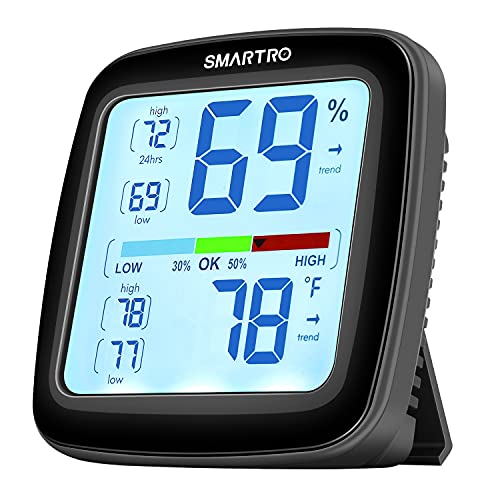
Keep a hygrometer in the room and treat 50 percent relative humidity as the ceiling rather than as a target to approach [3]. Above about 60 percent, growth on the organic materials listed above becomes plausible, and in a room used daily by children that is the number worth watching rather than any subjective sense of whether the space feels damp.
Respond quickly to any water event. Guidance from remediation bodies consistently puts the window for drying wet material at 24 to 48 hours before growth becomes likely, which means a small leak found on a Friday and dealt with on Monday has usually already crossed the threshold [4]. Wet carpet pad in particular is generally replaced rather than dried, because it holds water through the middle long after the surface feels dry.
Inspect the parts you cannot see on a schedule rather than on suspicion. Once or twice a year, pull furniture away from exterior walls, check the bottom few inches of drywall for staining or softness, look behind stored boxes, and check inside any built-in cabinetry against a foundation wall. These are the locations where a slow problem develops without announcing itself.
Signs Worth Acting On
The signals that justify investigation are mostly mundane. A persistent musty odor that returns after airing the room is the most reliable one, because it indicates microbial activity somewhere rather than a passing smell. Visible staining at the base of a wall, drywall that is soft to the touch near the floor, buckling or lifting at the edge of flooring, and white powdery deposits on the foundation all indicate water is or has been moving through.
There is also a pattern worth noticing that has nothing to do with the building: symptoms that appear in the basement and settle within a few hours of leaving it, or that improve during a stretch away from home and return afterward. That is a reason to check the space carefully rather than a diagnosis, and a persistent pattern is worth raising with a clinician who can weigh it against the alternatives.
FAQ
Is it safe for my kids to play in a finished basement?
If the space is properly maintained with good humidity control and no active moisture issues, yes — proactive management is particularly important given children’s potentially extended time in the space.
Should I have the basement air tested if my child has asthma?
Testing tells you less than most people expect. Spore counts vary hour to hour and there is no accepted safe threshold to compare a result against. If there is visible mold or a persistent damp smell, the money is better spent finding and fixing the moisture source, which is the action any test result would point toward anyway.
Is a dehumidifier enough to make a damp playroom safe to use?
It is enough for humidity that comes from the air, and it is the correct tool for condensation. It does nothing about water entering through the foundation, and running it against an active leak holds the room at a comfortable reading while material behind the wall stays wet.
How quickly does wet material actually become a problem?
Commonly cited remediation guidance puts it at 24 to 48 hours for damp organic material at normal room temperatures. That is the reason speed matters more than thoroughness in the first response to a leak.
Periodically inspect finished basement play areas for hidden moisture issues that might not be immediately visible.
References
- WHO guidelines for indoor air quality: dampness and mould. World Health Organization
- Mold Testing or Sampling. U.S. Environmental Protection Agency
- A Brief Guide to Mold, Moisture and Your Home. U.S. Environmental Protection Agency
- Mold Course Chapter 2: Why and Where Mold Grows. U.S. Environmental Protection Agency
These statements have not been evaluated by the Food and Drug Administration. This information is not intended to diagnose, treat, cure, or prevent any disease. Content is for informational purposes only and is not medical advice; consult a qualified healthcare provider before starting any supplement. As an Amazon Associate we earn from qualifying purchases.
